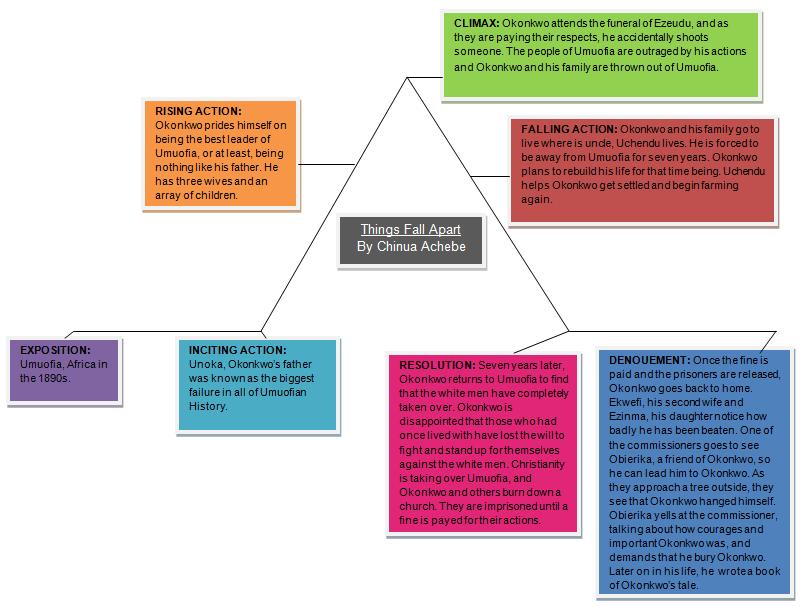
Things Fall Apart by Chinua Achebe
Mood:
Protagonist Deconstruction: |
Literary Devices and Figurative Language Simile: As I've come to find appears to be the recurring theme in many of the novels I've read this year, the author uses similes more than any other literary device. In this case, Chinua Achebe uses similes to illustrate Umuofia and those that mean so much to Umuofia. For instance, the first quote above from page 23 allows the reader to visualize the yams, which is something very important to the Umuofian people. The second quote is more direct and depicts the actual setting of Umuofia. The third quote above is to represent the lifestyle of the community. Metaphor: Metaphors were mainly used to do the same thing as the simile. Achebe used them less frequently, though the impact was roughly the same. The three metaphors above are used to describe Okonkwo and others he comes across through his journey of self-discovery. Repetition: Achebe's repetition of the word "nine" in the quote above is used to tell the story of Umuofia in the shortest explanation possible. "Nine" can relate Umuofia as a member of a family of other villages, though "the nine sons". Achebe's use of personification is used to tell the stories of the spirit of the forest. The personification of the forest shows just how powerful they believed the forest to be, for it possessed human-like characteristics. Onomatopoeia: Epithet: One thing that I think this novel relies a lot on is status, but it's a different kind of status than that of The Age of Innocence. Okonkwo cares so much about how he is viewed by other Umuofians, and Achebe's use of epithets give each character some sort of bragging right. The more epithets a character possesses, the more powerful they are (or that's at least how the reader views it). |
|
 |
||
